Tower Dash, an InOut Games production, packs each round into one tower that rises block after block until you bank the payout or the stack topples. Anyone opening Tower Dash for the first time usually checks the same handful of things: what a single tap triggers, how the multiplier rises, what can finish a round early and which figures the studio publishes.
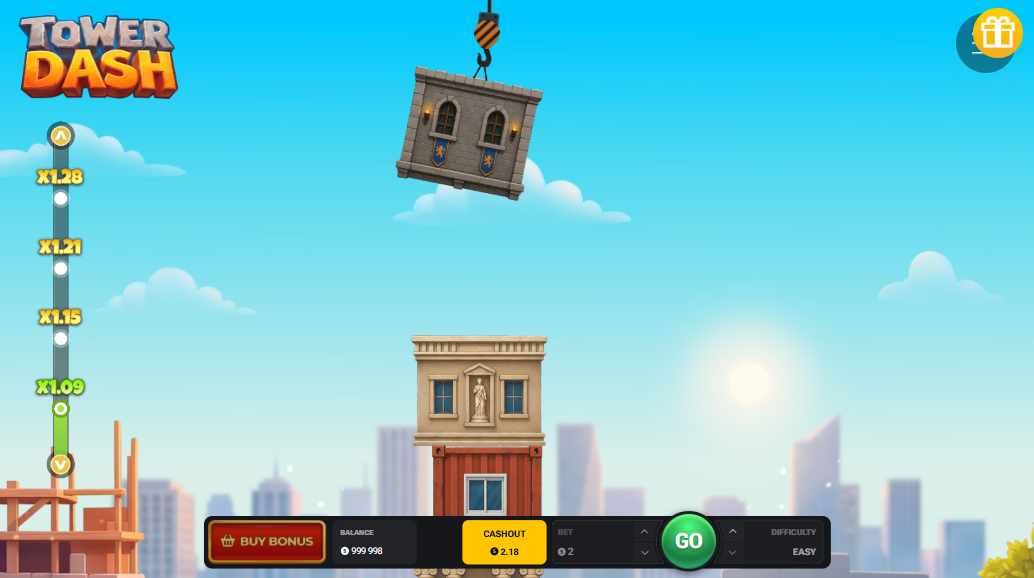
Those answers fit in a few lines. A crane hauls every block into place above the works, the load rocks to and fro, and a tap lets it go. Drop it neatly and the multiplier goes higher. Clip the edge instead and everything comes down, stake included.
In the pause between two blocks, a cash-out button lets you stop and collect.
The published return to player is 95.95%, the volatility rating spans medium to high, and payouts top out at 10,000x your stake, possible only once a tower reaches its greatest heights. Results come from an RNG that carries certification. Tapping moves the round along; the outcome is out of its reach.
There is also a free demo, play in any phone or computer browser, and real-money rounds at licensed casinos, restricted to adults of 18 or more. Every one of these points is unpacked below, beginning with a short grid of facts.
Key facts about Tower Dash
Skim the grid if time is short. Every line gets fuller treatment further down, so there is nothing to learn by heart.
| Feature | Tower Dash |
|---|---|
| Studio | InOut Games |
| Type | Quick-fire instant title, one tower per round |
| Theme | A building site full of cranes and stacked blocks set against a city skyline, with a bright, cheerful look |
| Special blocks | TNT crates, which finish the round; Wild blocks, which may rescue a messy drop |
| Cash-out | Offered in the gap between blocks |
| RTP | 95.95% |
| Volatility | Medium to high |
| Top win | 10,000x your stake, open only to the highest stacks |
| Demo | Free, using virtual chips, with no sign-up or deposit |
Three details are deliberately absent. Launch date, minimum and maximum stakes and any difficulty options are not given as fixed numbers here, since each casino's version lists them in its own game rules. That rules panel is where to confirm them, and it opens in seconds.
A few lines in the grid need more room than a single cell allows. Volatility and the top prize only become meaningful once you know how rare big outcomes are and what has to happen to reach them, so both return later.
The same applies to the two special blocks. One stops play instantly, the other can keep a wobbly stack going, and that contrast shapes a round more than any single number.
The idea behind the game
InOut Games chose a simple picture as its starting point: a tower climbing on a busy building site. Cranes move in front of distant high-rises, blocks settle on one another, and the palette is sunny rather than industrial. A newcomer understands the scene at a glance.
In industry terms this is an instant game. You will find no reels, no paylines and no feature wheel. A round runs while the tower holds, or until you choose to take the money, and then a fresh one begins on empty ground.
Pace accounts for much of the appeal. It is also a risk worth flagging from the start, because quick rounds can roll into each other and a session can run longer than intended without much warning.
Strip away the graphics and every Tower Dash round boils down to one dilemma. Is the multiplier on screen good enough, or does another block justify the risk? Your stake never changes mid-round, while the possible return grows with every neat landing.
The studio's job stops at the game. InOut Games produces it; the hosting casino looks after the account, payments in and out, and checks on age and identity. Knowing who does what makes later questions about limits or withdrawals much easier to route.
From first block to collapse
Each round runs through the same sequence. Below is that order, from placing a stake to the instant the tower either pays out or crumbles.
- Pick a stake. The casino's version states the permitted range in its rules, and the amount should match the budget you fixed for the session rather than the prize you would like.
- Begin. The crane swings in carrying block number one.
- Follow the movement. Suspended from the hook, it sways one way and back again.
- Tap. That single touch drops the block. It is the move you make, but the round's result is decided by the certified RNG all the same; timing, practice and experience leave it unchanged.
- See where it lands. A neat landing increases the multiplier and adds a storey. If the block overshoots the edge, the stack falls, ending play and costing you the stake.
- Choose at the button. In the gap before the next block, cashing out returns your bet times the figure now on screen. Purely as an illustration: cash out a NZ$0.90 stake at x14 and you receive NZ$12.60. This only demonstrates the sum. It does not suggest that any particular block, or any block at all, reaches x14 in a real round.
- Go on or leave. Carry on and the crane delivers another block, with steps 3 to 6 repeating until you collect or the stack falls.
Two special blocks may interrupt this sequence: the TNT crate and the Wild block. They push a round in opposite directions, so each is covered separately.
Booby-trapped TNT crates
The crane does not always bring a plain block. Now and then the load is a TNT crate, which is booby-trapped. Strike one and the game stops immediately.
For your balance, a crate works exactly like a collapse. Growth halts, the round closes, and that round's stake is lost. Any multiplier gathered so far vanishes too, unless the button had already been pressed.
No frequency for these crates is published. Previous rounds give no clue either. The RNG treats each round separately, so a long stretch without explosions reveals nothing about the following round, and two crates back to back do not make a third any rarer.
It is more useful to see TNT as a constant feature of the risk than as something to predict. It can appear in any round, and the published rules describe no warning sign.
That constant threat is what makes the button so important. Collecting between blocks is the one way to secure a payout before a crate or a missed landing finishes the round. Holding on for a safe moment is a guess, because the game has none built in.
Wild blocks in Tower Dash
Wild blocks are the helpful kind of special block. Their role and its limits:
- A Wild block may rescue a messy drop that would otherwise put the stack at risk.
- In that case the tower continues to rise and play continues rather than stopping.
- Your stake, the 95.95% RTP, and the 10,000x ceiling stay exactly as they were.
- Nobody can summon one. Its appearance, like everything else in a round, comes from the certified RNG.
- The studio publishes no rate for Wild blocks, so treat any figure you see quoted elsewhere with caution.
- Its help covers only the drop it saves. The next block must still land, and a TNT crate can still end things.
- It changes nothing about when to cash out. The choice at the button is the same with or without one.
In short, think of a Wild block as a reprieve for one drop, never as cover for the whole tower. Seeing it as a welcome extra rather than part of a plan keeps expectations grounded.
Cash out or stack another block
This choice drives everything else in Tower Dash. Between blocks the button is there, and tapping it ends the round and pays the stake at the current multiplier. Leaving it alone means accepting that the next drop might add a storey or flatten the lot.
No single rule fits every round. Taking small multipliers often and holding out for big ones rarely can both drain a balance over time, since the house edge implied by a 95.95% RTP works on either approach.
It helps to settle the question before the crane moves. Choose a multiplier you would be happy with and take it when it arrives. A target picked calmly is far easier to stick to than one made up while a tall stack sways.
Some habits make sessions worse. Going after huge multipliers following a run of small results is one. Raising bets to claw back earlier losses is another, and with a volatility rating this high it tends to go badly. Hurried taps and split-second choices belong here too, as the quick format already nudges you towards them.
None of this defeats the game. A plan only controls your own spending, which is the single part of a round that truly belongs to you.
Volatility and return
The studio gives two figures on how the game behaves across many rounds. Neither guarantees anything for one session, and the grid reads them that way.
| Figure | Value | Meaning |
|---|---|---|
| RTP | 95.95% | A long-run theoretical average over an enormous sample of rounds, never a prediction for tonight |
| Volatility | Medium to high | Outcomes vary sharply; long dry spells and bigger payouts are both part of normal play |
| Maximum win | 10,000x the bet | Kept for towers at their greatest height; the cap never rises |
| Launch date, stake limits, difficulty options | Game rules | Read them in the casino's own version |
A 95.95% RTP does not mean a session hands back that proportion of your deposits. Over a handful of rounds the actual result can sit well above or well under it, and the size of that gap is what the volatility label measures.
Medium to high volatility suits someone comfortable with patchy results who stakes with that in mind. Smaller bets give a budget room to ride out the quiet runs this rating implies.
Read the maximum as a limit, not a goal. It takes the tallest towers to hit it, and the payout cannot exceed 10,000x the stake whatever happens in the round.
A certified random number generator
An RNG with certification settles every round. That fact covers most of what needs saying about fairness.
Certification indicates that the generator was assessed for producing random output. It does not give you a way to check each round on your own, and no such tool is offered.
Randomness is also why rounds stand alone. A stack that fell at block two moments earlier has no bearing on the next attempt, and neither does a streak of tall towers. History records what happened and predicts nothing.
This is why anything claiming to decode the game deserves a wide berth. Predictors, bots and signal channels all say they can foresee a random draw, which no outside tool can do. Some want a fee, others your login details, and either is reason enough to walk away.
The tap sits plainly within this. It advances the round, yet it is not a skill that bends the result of Tower Dash. Playing Tower Dash slowly or quickly makes no difference to the odds either.
Demo and mobile play in Tower Dash
Two practical questions tend to come up early: can you try it without money, and will it work on a phone? Yes to both, with a few details.
Demo
The free version runs on virtual chips. You need no account and make no deposit, which makes it the quickest way to see the crane, the swaying load, both special blocks and the button in motion.
Anything won in the demo stays there. It cannot be cashed out, and it is no guide to real-money results, because both modes are equally random. Whether a particular casino offers the demo next to the paid version is that casino's decision.
Use the free mode to get used to how a round flows and to practise collecting at a planned multiplier, not to hunt for patterns.
Mobile
Play happens in the browser on desktop and mobile alike. On a phone, the screen turns portrait and one touch input runs everything, which suits a compact display.
Nothing needs installing. Treat any download, APK file or store listing presented as the official app as fake, and the same goes for lookalike sites that are not licensed casinos.
A steady connection matters, particularly right before a tap or a cash-out, and a quiet spot beats a packed train when real money is on the line.
Licensed casinos and age rules
Real-money access depends on the operator, not the studio. Things to confirm:
- Stick to operators that hold a licence and stock InOut Games titles; that licence should be visible and verifiable.
- Real-money rounds are for adults only, 18 and above.
- Make sure the operator accepts customers from the country you live in, and look at the stake limits it applies to the game.
- Go through bonus conditions carefully. Every operator decides how instant games contribute to wagering, which titles are barred, and the biggest bet you may place while a bonus runs.
- The normal path runs from registration to identity checks, then a deposit, then the instant games category where the title usually sits.
- Send account, deposit and withdrawal questions to the operator; the studio has no role there.
- Ignore unlicensed sites, even if they show the game's artwork.
Small stakes first
Low stakes are the most valuable habit for a quick, swingy game. A modest bet stretches a budget across more rounds, and more rounds make medium to high volatility easier to manage.
Ahead of your first paid tower, set a spending cap for the session and a time limit. Set a loss threshold inside that cap as well, and quit once it is reached instead of hoping the next round repairs the damage. A target for the session works the other way: hitting it is a good moment to close the game.
Pauses count for more than people expect. Rapid rounds merge, and stepping away from time to time shows clearly how much time and money have been spent.
Licensed operators generally let you set deposit and time limits from your account. Switching them on turns intentions into rules the account applies automatically. Self-exclusion exists as well, for anyone who wants a longer break from play.
If Tower Dash, or gambling generally, no longer feels like fun, the next step is a professional help organisation. Making that call sooner tends to be easier than putting it off.
Points worth knowing about Tower Dash
Some facts are best learned now rather than halfway through a session.
| Point | What it means for you |
|---|---|
| A missed landing finishes the round | You lose that round's stake |
| A TNT crate finishes the round | The result matches a collapse: the stake is gone |
| The volatility rating spans medium to high | Sessions can differ sharply from one to the next |
| The top prize has a ceiling | 10,000x your stake, limited to the tallest towers |
| Your tap does not set the outcome | The certified RNG decides each round |
| Nothing guarantees a win | Systems, predictors and tips cannot outsmart randomness |
| Demo winnings stay virtual | Chips from the free mode cannot be withdrawn |